

Safety alerts
25 MAY 2026 – UPDATED URGENT – PRODUCT CORRECTION
MiniMed Mobile App (Android version) App/Pump Disconnection Issue
TGA Reference: RC-2026-RN-00381-1
ARTG: 408370
| Product: | Model/CFN Number: |
| MiniMed Mobile App | MMT-6101 (Android) Version: 3.2.0 |
Dear Valued Customer:
Medtronic is contacting you regarding MiniMed Mobile App Android software version 3.2.0. We identified a problem where the app disconnects from the pump. This email provides instructions on how to correct the problem by updating your MiniMed Mobile App to the latest version 3.2.1 or higher, if you have not already done so.
Customer Action Required:
- Users of MiniMed Mobile App Android software version 3.2.0 should update to version 3.2.1 or higher as soon as possible to resolve this problem if they have not already done so. Please click on the link below to download the new version of the app.
https://play.google.com/store/apps/details?id=com.medtronic.diabetes.minimedmobile.eu
To confirm the latest app version on your Android device, follow the steps below.
- Open the Google Play Store app.
- Tap Menu and then Manage apps & devices.
- Apps with an update available are labeled "Update available.” You can also search for a specific app.
- Tap Update.
Regardless of if your MiniMed Mobile App version is affected, please acknowledge that you have read and understood this notification and have followed the actions listed in this notification by using the button below.
Problem Description:
For MiniMed Mobile App Android version 3.2.0, the following problems were identified.
- Disconnection between the MiniMed Mobile Android app and the pump, with a "Pump Communication Error" message displayed. Pump data and alerts are not displayed in the MiniMed Mobile Android app version 3.2.0.
- Subsequent pairing attempts between the MiniMed Mobile Android app and the pump fail.
- Periodic data from the pump fails to upload to CareLink, and the latest data is not included if attempting to generate a CareLink report.
- If you have a linked care partner using the CareLink Connect app (MMT-6111/MMT-6112), the care partner will not receive active notifications, but will receive a displayed notification after 15 minutes that no new data is being sent from the followed MiniMed Mobile Android App user.
Risk to Health:
This issue may result in inconvenience for impacted MiniMed Mobile App Android version 3.2.0 users, as the MiniMed Mobile App cannot be used as a secondary display and users must rely on the primary pump display. However, the insulin pump and Continuous Glucose Monitoring (CGM) functionality are not affected.
In addition, this problem can result in HCPs not having the most recent data in CareLink report, and care partners not receiving data in the CareLink Connect app. Per the MiniMed Mobile and CareLink Connect Apps’ Instructions for Use (IFU), dosing decisions should not be made based on information in the applications, and therapy decisions should always be made following instructions on the insulin pump or CGM system.
Additional Information
Medtronic is initiating this action in consultation with the Therapeutic Goods Administration.
Local Contact Details
As always, we are here to support you and ensure we deliver the highest quality products possible. If you have further questions or need assistance, please call the Medtronic 24-Hour Technical Support line at 1-800-777 808.
Sincerely,

Lewis Hong
Sr Post Market Vigilance Specialist | Quality and Regulatory Affairs
Medtronic
Medtronic Australasia Pty Ltd
Level 8, 11 Khartoum Road | Macquarie Park, NSW, 2113 | Australia
lewis.l.hong@medtronic.com
medtronic.com.au | Facebook | LinkedIn | Twitter | YouTube
April 2026 – UPDATED URGENT – PRODUCT CORRECTION
Pump Delivery Volume Accuracy (DVA) during Changes in Air Pressure
TGA Reference: RC-2025-RN-00061-1
ARTG: 308140 / 332201 / 376091 / 484825 / 484826
| Insulin Pump | Model/CFN Number |
| Paradigm™ | MMT-512, MMT-522, MMT-523, MMT-551, MMT-554, MMT-712, MMT-715, MMT-722, MMT-723, MMT-751, MMT-754 |
| MiniMed™ 640G Insulin Pump | MMT-1711, MMT-1712, MMT-1751, MMT-1752 |
| MiniMed™ 670G Insulin Pump | MMT-1762, MMT-1782 |
| MiniMed™ 770G Insulin Pump | MMT-1881,MMT-1891 |
| MiniMed 780G Insulin Pump | MMT-1885, MMT-1895 |
Dear Valued Customer:
Medtronic is contacting you about an update to the Urgent Product Correction regarding your MiniMed™ insulin pump. During quality testing performed by Medtronic, we recently found that changes in air pressure can cause unintended insulin delivery. For example, air pressure in an airplane can change rapidly during flight, which may cause expansion of tiny air bubbles inside the insulin reservoir.
The update is to highlight 02 new ARTG numbers.
Problem Description:
- When air pressure decreases (e.g., during flight takeoff), more insulin may be released than expected. Additionally, unintended insulin may be released even if the pump’s delivery is suspended or programmed to zero units per hour.
- When air pressure increases (e.g., during flight landing), less insulin may be released than expected.
Risk to Health:
The changing air pressure conditions could result in more insulin being delivered during flight takeoff, potentially leading to hypoglycemia, or less insulin being delivered during flight landing, potentially leading to hyperglycemia.
Between July 2003 and May 2024, Medtronic received 138 complaints potentially related to this problem, 19 of which reported serious injuries, but none were confirmed to be related to this problem. It is important to monitor your glucose frequently while flying and be prepared to treat hypoglycemia or hyperglycemia. Individuals with lower daily insulin doses and those with high insulin sensitivity may experience greater changes in glucose during changes in air pressure than individuals with higher insulin doses and/or lower insulin sensitivity. If you are unsure as to whether this applies to you, it is important that you seek your healthcare professional’s treatment guidance.
Recommended Actions for Pump Users:
- Monitor Your Glucose Levels: Check your glucose frequently during activities like air travel, amusement park rides, or other situations where sudden changes or extremes of air pressure, altitude, or gravity may occur.
- Discuss how to prepare for situations like this with your healthcare professional. Keep an emergency kit with rapid-acting glucose and backup insulin therapy available at all times.
- Respond to Alerts and Symptoms: Pay attention to any alerts from your pump as well as symptoms of hypoglycemia or hyperglycemia. Follow your healthcare professional's treatment instructions in these situations.
Please acknowledge that you have read and understood this notification and have followed the actions listed in this letter by scanning the QR code below with your contact details.
Additional Information
Medtronic is initiating this action in consultation with the Therapeutic Goods Administration.
Local Contact Details
As always, we are here to support you and ensure we are delivering the highest quality products possible. If you have further questions or need assistance, please call the Medtronic 24-Hour Technical Support line at 1800-777 808.
March 2026 – URGENT – PRODUCT DEFECT CORRECTION
MiniMed™ Paradigm™, 600 series, and 700 series insulin pump systems
Pump Placement with Respect to Infusion Site
TGA Reference: RC-2026-RN-00154-1
ARTG: 95763, 308140, 332201, 376091, 484825, 484826
Products impacted:
MiniMed™ Paradigm™ Insulin Pumps (all models)
MiniMed™ 640G, 670G, 770G, 780G Insulin Pumps (all models)
Dear Valued Customer:
We are contacting you with guidance about how to position your pump and infusion set. Please note that this issue and the required actions apply to all MiniMed™ Paradigm™, MiniMed™ 600 Series, and MiniMed™ 700 Series pump models.
Problem Description:
- Due to environmental conditions, there may be slight variability in the amount of insulin delivered when your pump is worn at distances above or below the location of your infusion set.
- This variability may increase with increasing distances above or below your infusion set location.
- Placing the pump above your infusion site can cause over-delivery and placing it below your infusion site can cause under-delivery.
- The greatest variability in insulin delivery may occur at distances beyond 35.5 cm above or below your infusion set location.
- This variability in insulin delivery will not be captured in your pump’s history or CareLink reports.
Customer Action Required:
- Keep the location of your insulin pump close to your infusion site.
- If you need to raise the pump above your infusion site, such as when a parent or caregiver is using the pump for a child, limit the time that the pump is held above the infusion site.
- Pay attention to any alerts from your pump as well as symptoms of hypoglycemia and hyperglycemia; follow your healthcare professional's treatment instructions in these situations.
- If you have any concerns about how this may impact insulin delivery and blood glucose, please contact your healthcare professional. You may also contact the Medtronic 24-Hour Technical Support line at 1-800-777 808 with any questions about this notification.
- Please keep a copy of this notice with the Instructions for Use for your pump.
Please acknowledge that you have read and understood this notification and have followed the actions listed in this letter by scanning the QR code below with your phone or tablet, to acknowledge this communication.
Risk to Health:
- Individuals who require lower daily insulin doses and those with high insulin sensitivity may experience changes to their blood sugar (hypoglycemia or hyperglycemia) because of this phenomenon.
- If you are unsure whether this applies to you, it is important that you seek guidance from your healthcare professional.
As of February 9, 2026, Medtronic has not identified any user complaints that can be attributed to this problem.
Medtronic Actions or Further Information:
Medtronic MiniMed will update the User Guides for our currently distributed insulin pumps to include the following:
"It is important to keep the location of your pump stable relative to your infusion site. Do not wear or place your pump more than 14 in (35.5 cm) above your infusion site. Doing so can cause an over-delivery of insulin, which may result in hypoglycemia."
Additional Information:
Medtronic is initiating this action in consultation with the Therapeutic Goods Administration.
Local Contact Details:
As always, we are here to support you and ensure we deliver the highest quality products possible. If you have further questions or need assistance, please call the Medtronic 24-Hour Technical Support line at 1-800-777 808.
February 2025 - URGENT – PRODUCT DEFECT CORRECTION
Pump Delivery Volume Accuracy (DVA) during Changes in Air Pressure
TGA Reference: RC-2025-RN-00061-1
ARTG: 308140 / 332201 / 376091
| Insulin Pump | Model/CFN Number |
| Paradigm™ | MMT-512, MMT-522, MMT-523, MMT-551, MMT-554, MMT-712, MMT-715, MMT-722, MMT-723, MMT-751, MMT-754 |
| MiniMed™ 640G Insulin Pump | MMT-1711, MMT-1712, MMT-1751, MMT-1752 |
| MiniMed™ 670G Insulin Pump | MMT-1762, MMT-1782 |
| MiniMed™ 770G Insulin Pump | MMT-1881,MMT-1891 |
| MiniMed 780G Insulin Pump | MMT-1885, MMT-1895 |
Dear Valued Customer:
Medtronic is contacting you about an Urgent Medical Device Correction regarding your MiniMed™ insulin pump. During quality testing performed by Medtronic, we recently found that changes in air pressure can cause unintended insulin delivery. For example, air pressure in an airplane can change rapidly during flight, which may cause expansion of tiny air bubbles inside the insulin reservoir.
Problem Description:
- When air pressure decreases (e.g., during flight takeoff), more insulin may be released than expected. Additionally, unintended insulin may be released even if the pump’s delivery is suspended or programmed to zero units per hour.
- When air pressure increases (e.g., during flight landing), less insulin may be released than expected.
Risk to Health:
The changing air pressure conditions could result in more insulin being delivered during flight takeoff, potentially leading to hypoglycemia, or less insulin being delivered during flight landing, potentially leading to hyperglycemia.
Between July 2003 and May 2024, Medtronic received 138 complaints potentially related to this problem, 19 of which reported serious injuries, but none were confirmed to be related to this problem. It is important to monitor your glucose frequently while flying and be prepared to treat hypoglycemia or hyperglycemia. Individuals with lower daily insulin doses and those with high insulin sensitivity may experience greater changes in glucose during changes in air pressure than individuals with higher insulin doses and/or lower insulin sensitivity. If you are unsure as to whether this applies to you, it is important that you seek your healthcare professional’s treatment guidance.
Recommended Actions for Pump Users:
- Monitor Your Glucose Levels: Check your glucose frequently during activities like air travel, amusement park rides, or other situations where sudden changes or extremes of air pressure, altitude, or gravity may occur.
- Discuss how to prepare for situations like this with your healthcare professional. Keep an emergency kit with rapid-acting glucose and backup insulin therapy available at all times.
- Respond to Alerts and Symptoms: Pay attention to any alerts from your pump as well as symptoms of hypoglycemia or hyperglycemia. Follow your healthcare professional's treatment instructions in these situations.
Please acknowledge that you have read and understood this notification and have followed the actions listed in this letter by scanning the QR code below with your contact details.
Additional Information
Medtronic is initiating this action in consultation with the Therapeutic Goods Administration.
Local Contact Details
As always, we are here to support you and ensure we are delivering the highest quality products possible. If you have further questions or need assistance, please call the Medtronic 24-Hour Technical Support line at 1800-777 808.
August 2024 - URGENT – SAFETY ALERT
MiniMed™ 600 series and 700 series pump systems — battery status alerts and alarms
TGA Reference: RC-2024-RN-00692-1
Product:MiniMed™ 640G (ARTG: 95763 cancelled)
MMT-1711K, MMT-1711KL, MMT-1712KL, MMT-1751B, MMT-1751H, MMT-1751K, MMT-1751P, MMT-1751W
MiniMed™ 670G (ARTG: 308140)
MMT-1782K, MMT-1782KL, MMT-1762KAU, MMT-1762K
MiniMed™ 770G (ARTG: 332201)
MMT-1881, DEMMT-1881, MMT-1881L, 1881X, MMT-1891UWW, MMT-1891
MiniMed™ 780G (ARTG: 376091)
MMT-1885, MMT-1885L, MMT-1895, MMT-1895WWA
Dear Valued Customer:
Medtronic is contacting you with a reminder about the importance of following your pump’s built-in alerts and alarms for battery status when they are displayed on the pump, as outlined in the instructions for use. The MiniMed™ 600 series and 700 series pump systems are designed to monitor the pump’s battery life over time and will generate a series of visual, audible, and vibratory low battery alerts and alarms to remind you when it is time to replace the battery.
- The “Low Battery Pump” alert will display when your pump has up to 10 hours of battery life left.
- The “Replace Battery” alert will display when the pump has less than 30 minutes of battery life left.
- If the battery is not replaced within 10 minutes, a siren will sound and repeat once every minute until the “Replace Battery Now” alarm is displayed. At that time, the pump will stop insulin delivery.
If the battery is not replaced within 10 minutes of this alarm, a siren will sound, and the pump will shut down.
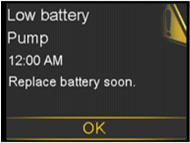
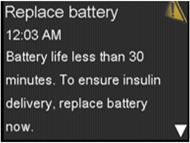
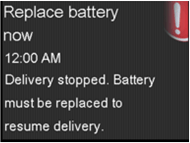 Visual Pump Notifications before Battery Depletion
In addition, the pump displays the battery status on the home screen.
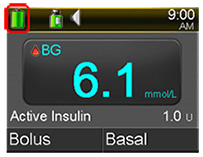 Example of Battery Icon on Pump Home Screen Status Bar
Problem Description:
We have found that in some instances, pumps that have been dropped, bumped, or experienced physical impact, may have damage to internal electrical components, which may cause reduced battery life on the pump. Please note that even a single drop could result in reduced battery life, either immediately after the drop, or over time. Your pump will still generate low battery and replace battery alerts and alarms; however, these notifications may display sooner than expected, resulting in the battery needing to be replaced sooner than expected. No serious injuries have been confirmed to be related to the battery depleting sooner than expected on MiniMed™ 600 and 700 series pumps.
Recommended Actions for Customers:
- Always pay attention to alerts and alarms displayed on your pump.
- Be aware that you can check your pump’s battery level anytime on the status bar located on the pump home screen.
- If your pump has been dropped, bumped, or has experienced physical impact, pay special attention to any pump alerts and alarms, including low battery alerts, as they may occur earlier than expected. Follow any prompts on the pump to replace the battery. Refer to your pump’s instruction for use for directions on how to replace the battery. If you notice any significant changes in battery life or need additional troubleshooting assistance, please contact the Medtronic 24-Hour Technical Support line for further help.
- Ensure you always have extra new AA lithium or alkaline batteries or fully charged NiMH batteries available, along with your other emergency kit supplies.
- As indicated in the pump’s user guide, keep an emergency kit available at all times to confirm that necessary supplies are ready.
Additional Information
Medtronic is initiating this action in consultation with the Therapeutic Goods Administration.
Local contact details
We are committed to patient safety and welcome any questions you may have regarding this communication. Please do not hesitate to contact the Medtronic 24-Hour Technical Support line at 1800 777 808.
May 2024 – URGENT PRODUCT DEFECT CORRECTION
Insulin Pump - Using Compatible Battery Cap
TGA Reference: RC-2024-RN-00402-1 – a follow on action from RC-2022-RN-00725-1
ARTG: 95763, 308140, 332201, 376091
Product: All MiniMed™ 600 series and MiniMed™ 700 series insulin pump models, including MiniMed™ 640G, MiniMed™ 670G, MiniMed™ 770G, and MiniMed™ 780G
Dear Valued Customer:
We’ve previously reached out to you about a potential issue with the battery cap on the MiniMed™ 600 series and MiniMed™ 700 series insulin pumps and provided actions they should take. We are pleased to inform you that we have developed a new battery cap for these pumps, which addresses the potential issues with the previous battery cap (model ACC-1527). We have included the new battery cap (model ACC-1529) for use with your previous case insulin pump with this letter. Thanks for your patience as we work to continuously improve your experience, your safety is our top priority.
Pump cases:
Separately from the new design of the battery cap, Medtronic has also changed the design of the outer case on some MiniMed™ 700 series insulin pumps. The outer case of MiniMed™ 600 series insulin pumps has not changed. Pumps impacted by this battery cap contact issue have the previous case design only. Each case has different battery cap, the battery caps are not compatible with the other case. The actions section below lists steps to identify the case on your insulin pump and the compatible battery cap.
You are receiving this letter as you were identified as having a pump with the previous case design.
Customer Action Required:
Replace the battery cap on your previous case insulin pump by following the steps below. Order the new battery cap for your previous case pump (model ACC-1529), by calling Medtronic 24-hour Technical Support at 1800 777 808.
If you have a MiniMed™ 700 series pump, identify your insulin pump(s) as a previous case pump or a new case insulin pump. If you have a MiniMed™ 600 series pump, the pump has a previous case design only.
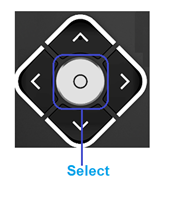
- To identify if you have a new pump case on your MiniMed™ 700 series pump, navigate to Menu by clicking the ‘Select’ button.
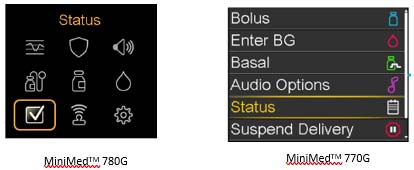
- On the Menu screen select Status. On MiniMed™ 780G insulin pumps this will be the icon in the bottom left corner.
- On the Status screen select Pump.
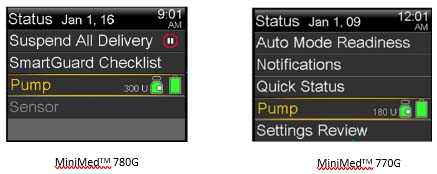
- On the Pump screen, scroll down to check the Hardware version. If you have a new pump case, the Hardware version will begin with A2. If you have a previous case pump, the Hardware version either will not appear on the screen or shows A1.
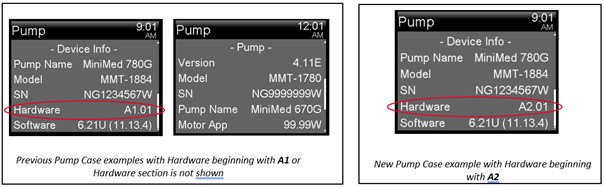
- Another way to identify the new pump case is to look at the serial number on the outside of the pump. The serial number is located on the back of the pump underneath the belt clip. The serial number on the new pump case is laser etched onto the back of the pump whereas the serial number is on a silver sticker on the previous case pump.
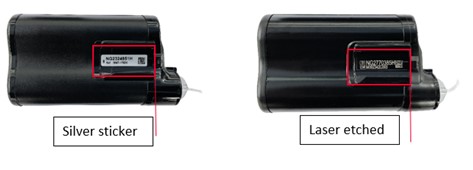
Replace the battery cap on your previous case pump by following the steps below.
- Gather previous case insulin pump and all battery caps in your possession.
- Only replace the battery cap on your previous case pump. If you have a new case pump, do not replace the cap on it.
- Before you begin, make sure you have a new battery available; do not remove the battery cap unless you have a new battery available.
- Look at the bottom and top of each battery cap and identify which battery cap(s) is the new cap (model number ACC-1529) for your previous case pump and which is the previous battery cap(s) (model number ACC-1527) using the pictures below:
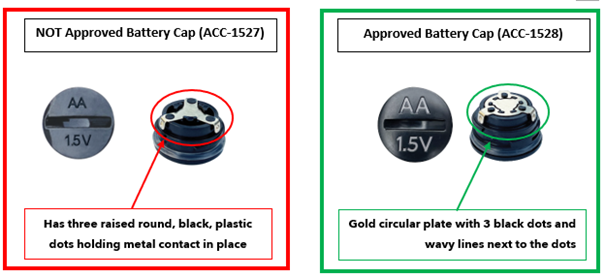
- Discard all battery caps not approved for your pump (model number ACC-1527). There is no need to return anything to Medtronic.
- Install the new battery cap (model number ACC-1529) onto your previous case pump.
- The battery cap provided is for your primary previous case insulin pump. If you are using more than one previous case pump impacted by this issue, please request an additional cap by calling Medtronic 24-hour Technical Support at 1800 777 808.
Issue Description:
The previous battery cap (model ACC-1527), used on previous case insulin pumps, has a contact issue that can potentially result in an incomplete battery connection, leading to no power source to the pump. When the pump detects no power source, an “Insert battery” alarm will occur, and insulin delivery will immediately stop. After 10 minutes, the alarm sound will increase to a siren, and the pump will turn off.
If the pump stops delivery of insulin due to power loss, this could lead to varying degrees of high blood sugar, including diabetic ketoacidosis (DKA). Serious injuries have been reported with the use of the MiniMed™ 600 series and MiniMed™ 700 series previous pump case insulin pumps associated with the damaged cap, but not all have been directly correlated to this issue based on review with independent clinical experts. Damaged battery cap contacts could potentially lead to those events explained above. Please notify Medtronic of any adverse events, if the metal contact on your battery cap is damaged, or other problems associated with your use of this product by calling the Medtronic 24-Hour Technical Support line at 1800 777 808.
Please acknowledge that you have read and understood this notification and have followed the actions listed in this letter. Acknowledge
Additional Information
Medtronic is initiating this action in consultation with the Therapeutic Goods Administration.
Local contact details
We are committed to patient safety and welcome any questions you may have regarding this communication. Please do not hesitate to contact Medtronic 24-Hour Technical Support line at 1800 777 808.
Sincerely,
Tasheena Gul
Post Market Vigilance Specialist | Quality and Regulatory Affairs